

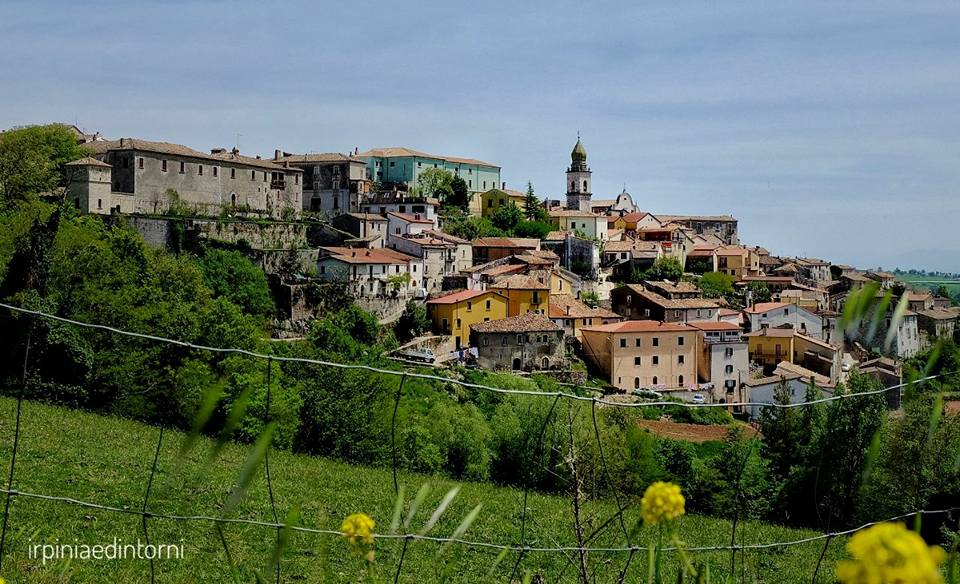
Location
In the heart of the Beneventano region, Santa Croce del Sannio appears as a small village suspended in time. Located among the mountains of the Campanian Apennines, at over 700 meters above sea level, it overlooks the valley of the Tammaro River with its breathtaking view. Halfway between Benevento and Campobasso, this village is a crossroads of stories, a bridge between the past and the present.
Not to be missed
Religious architecture:
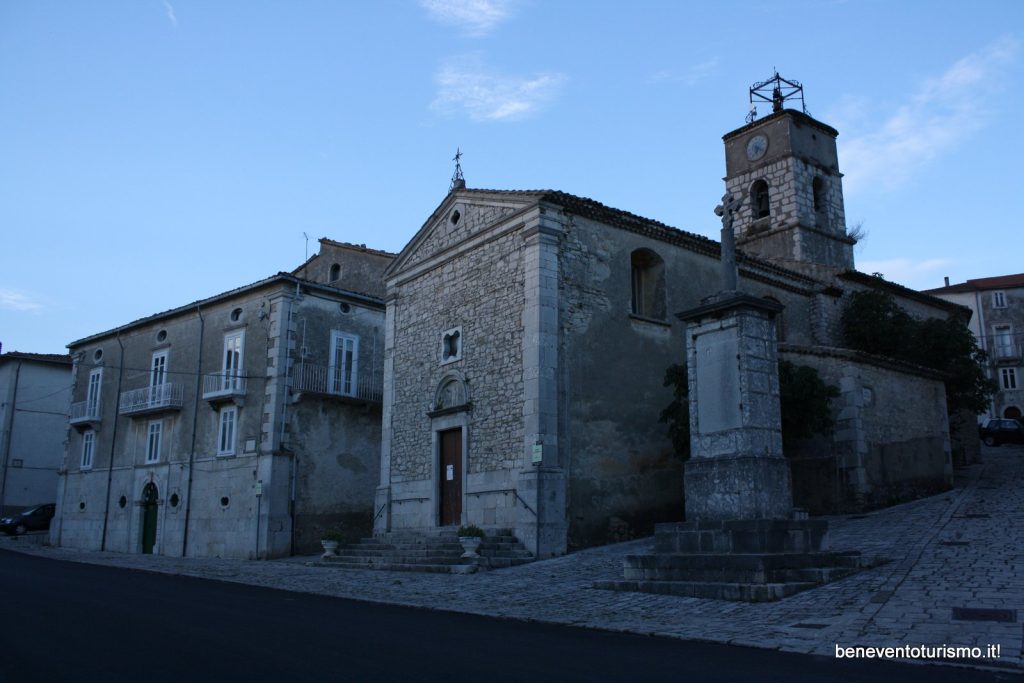
Church of St. Sebastian
At the beginning of the 18th century, the Church of St. Sebastian was located outside the walls, in front of Porta Nuova. The facade, made of local stone, bears the coat of arms of the Del Balzo family and the date 1536, indicating a restoration of the church, which had been built in ancient times. In 1786, near the church, an epitaph was erected with the decree of King Ferdinand IV, which established the weekly cattle market in Santa Croce del Sannio. The decree refers to the medieval event “La Pace,” essential for the market, which would have been suspended if not celebrated.
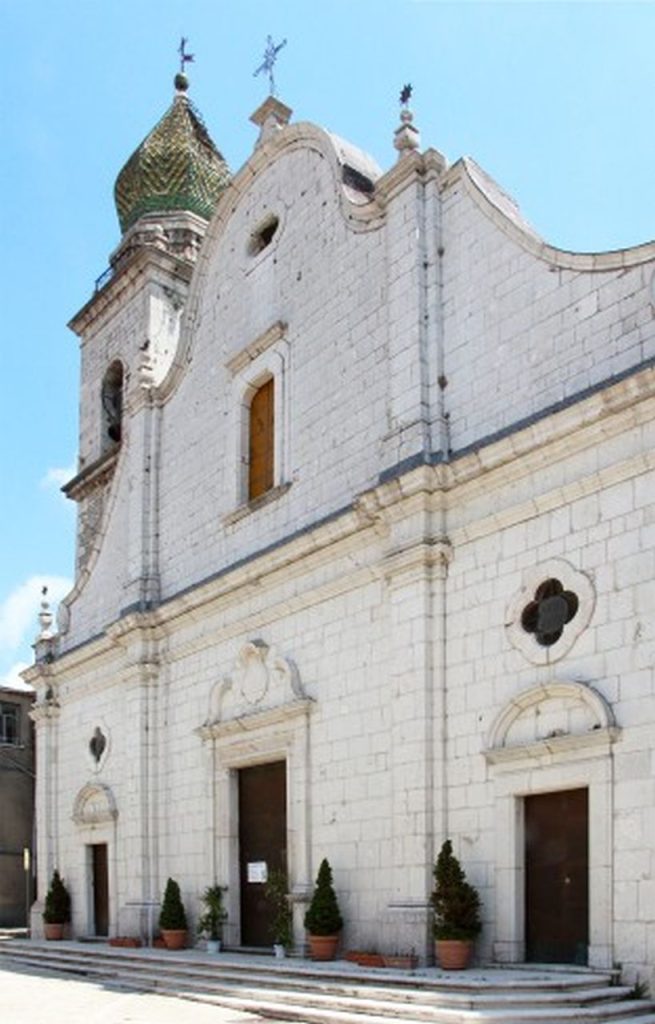
Mother Church of the Assumption of the Blessed Virgin Mary
The church dedicated to the Holy Cross, now the Church of Santa Croce and Franciscan convent, dates back to the 7th-8th centuries A.D. With its characteristic bell tower, it majestically overlooks the town center.
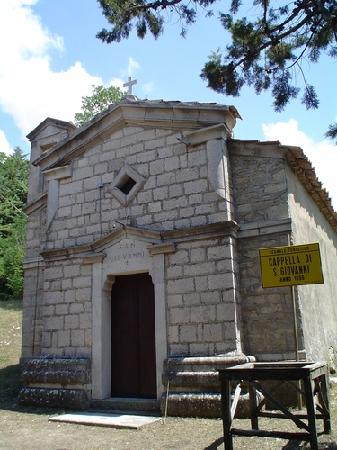
Chapel of St. John
Probably existing as early as the 13th century, this simple and austere chapel is entirely built of stone, with an elegant bell tower. It stands isolated in the open countryside, along a wooded path equipped for pleasant rest stops. The small church still retains its original frescoes in the apse.
Civil architecture:
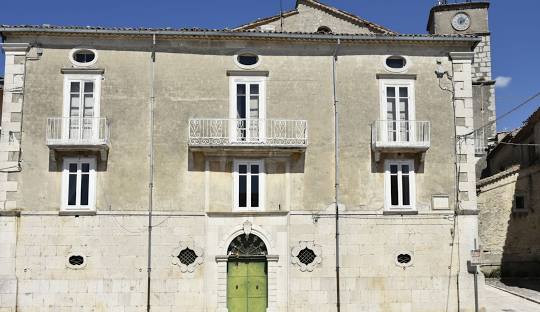
The Palazzo de Nigris-Di Maria dates back to the late 18th century. It has a clearly proportional composition: around a fairly spacious central area, where the stair ramps directly lead, there are two rooms on each side arranged symmetrically. This layout is repeated on each of the three levels. On the ground floor, the central space served as a public area, allowing the host to welcome family members, clients, friends, and workers without imposing ritualistic and discriminatory behavioral rules.
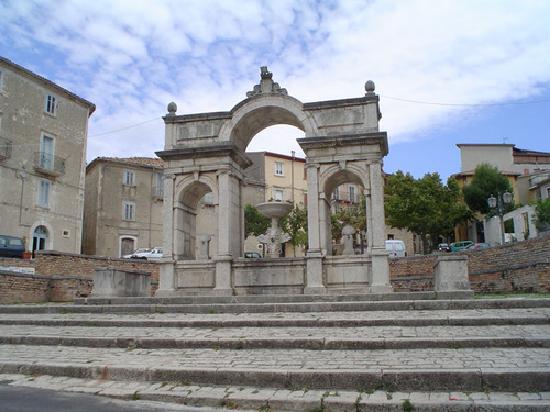
Monumental Fountain
A triple-arched fountain, built at the end of the 19th century based on a design by the architect Parente.
A bit of history
Santa Croce del Sannio takes its name from the Church of Santa Croce, dating back to the 7th-8th century A.D., with a Franciscan convent that dominates the town center. In 762, King Desiderius ceded the property to Theodemario, an abbot. By the year 1000, Santa Croce was a settlement of the Cassinese monks, from which the powerful San Croce family originated. It later passed to Rodolfo Alemagno between 1172 and 1183, and in 1277, to Guglielmo di San Croce. In 1456, Ferdinand I of Aragon assigned it to Giovan Battista del Balzo. In 1561, there was a plague epidemic in Cercemaggiore. The feudal estate then passed to the Tramontano family of Sorrento. Santa Croce was part of the Molise region and, in 1861, became part of the province of Benevento.
The local economy was based on agro-pastoralism and transhumance, typical of the Apennine regions. Today, Santa Croce del Sannio is a picturesque mountain village, with a historic center full of 18th-century buildings and a Chiesa Matrice (Mother Church) made of local stone. The community closely preserves its cultural and historical identity, visible in its traditions, cuisine, and folklore.
Curiosity
The Sagra dell’Agnello (Lamb Festival) is an annual event in Santa Croce del Sannio. This celebration honors the local culinary tradition, offering dishes made with lamb from livestock raised on the royal transhumance route. During the festival, visitors can enjoy various lamb specialties, such as roasted lamb, baked with potatoes, or stew, accompanied by other typical dishes and local beverages. The evenings are filled with live music and other forms of entertainment.
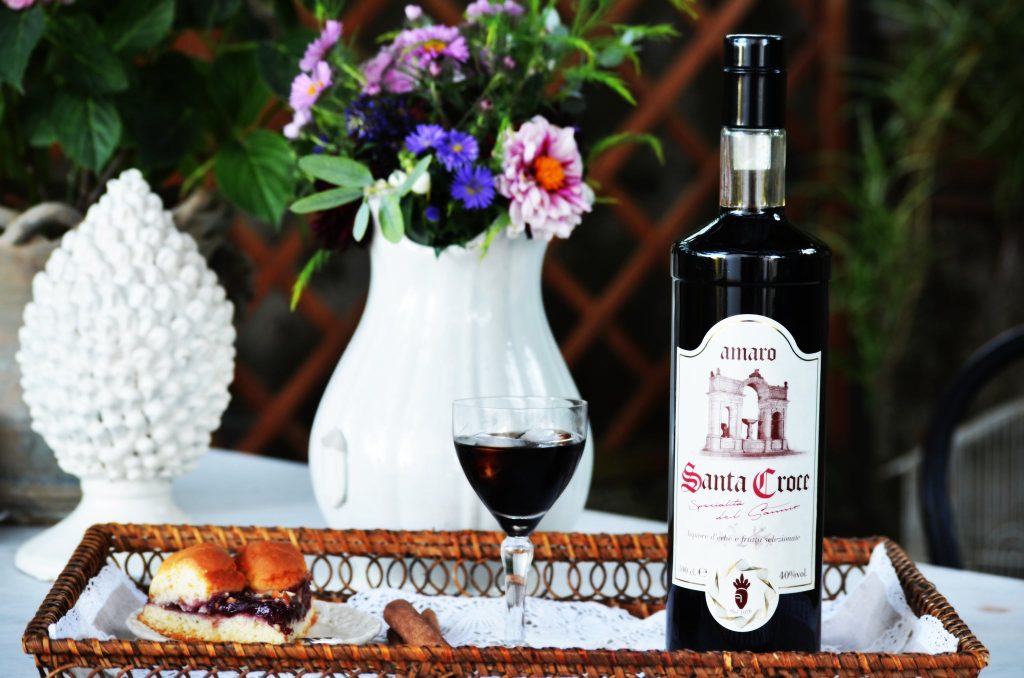
Amaro Santa Croce has been produced since the early 1900s, after the end of World War I. Its recipe was lost and rediscovered in 1975. Today, it is still produced with great success. The preparation involves the infusion of aromatic herbs, roots, and local citrus fruits.
The Sagra della Scamorza (Scamorza Festival) is held annually in Santa Croce del Sannio. The event celebrates scamorza, a cheese that is a staple of the local dairy tradition, highly appreciated for its flavor and versatility in cooking.